
Circles of Concern, Influence and Control
Habit 1: Be Proactive[1]
Welcome to the first in a series of practical tools for navigating everyday work challenges. Concepts and frameworks – or mental models - are really useful for providing the building blocks for us to reason through a conundrum or concern. They enable us to go beyond our immediate responses to recognise patterns, develop new perspectives and challenge our own assumptions and actions. The first in this series provides a guide to circles of concern, influence and agency popularised by Stephen Covey in his book The 7 Habits of Highly Successful People..
There are very strong “Us and Them” discourses in universities. Depending on which part of a university hierarchy you sit in, “Them” tend to be management and leaders. Or, if you are an academic, “Them” might be your professional service colleagues or another academic department.
Whoever is your “Them” I hazard a guess you spend a fair bit of your time talking to your colleagues about their general uselessness and other failures. Indeed, at a recent training day I ran, a large part of the morning was spent with participants commenting on how their university leadership was doing everything wrong.
When I asked what they, as individuals or as teams, could do about this there was silence. The question had never come up. This moment stuck with me because it perfectly illustrates why the “Circles” framework matters.
In a world full of uncertainty and a university full of challenges, stress and anxiety often comes not from what happens to us but from how we respond. The concept of circles of concern, influence and control is all about enabling us to understand what we can do about something about and what we can’t. By focussing on what you can do you are more likely to feel in control of a situation rather than helpless in the face of whatever is challenging you. And understanding this can dramatically improve decision-making, emotional well-being, and effectiveness in daily life.
At a Glance: Circles of Concern, Influence and Control[2]
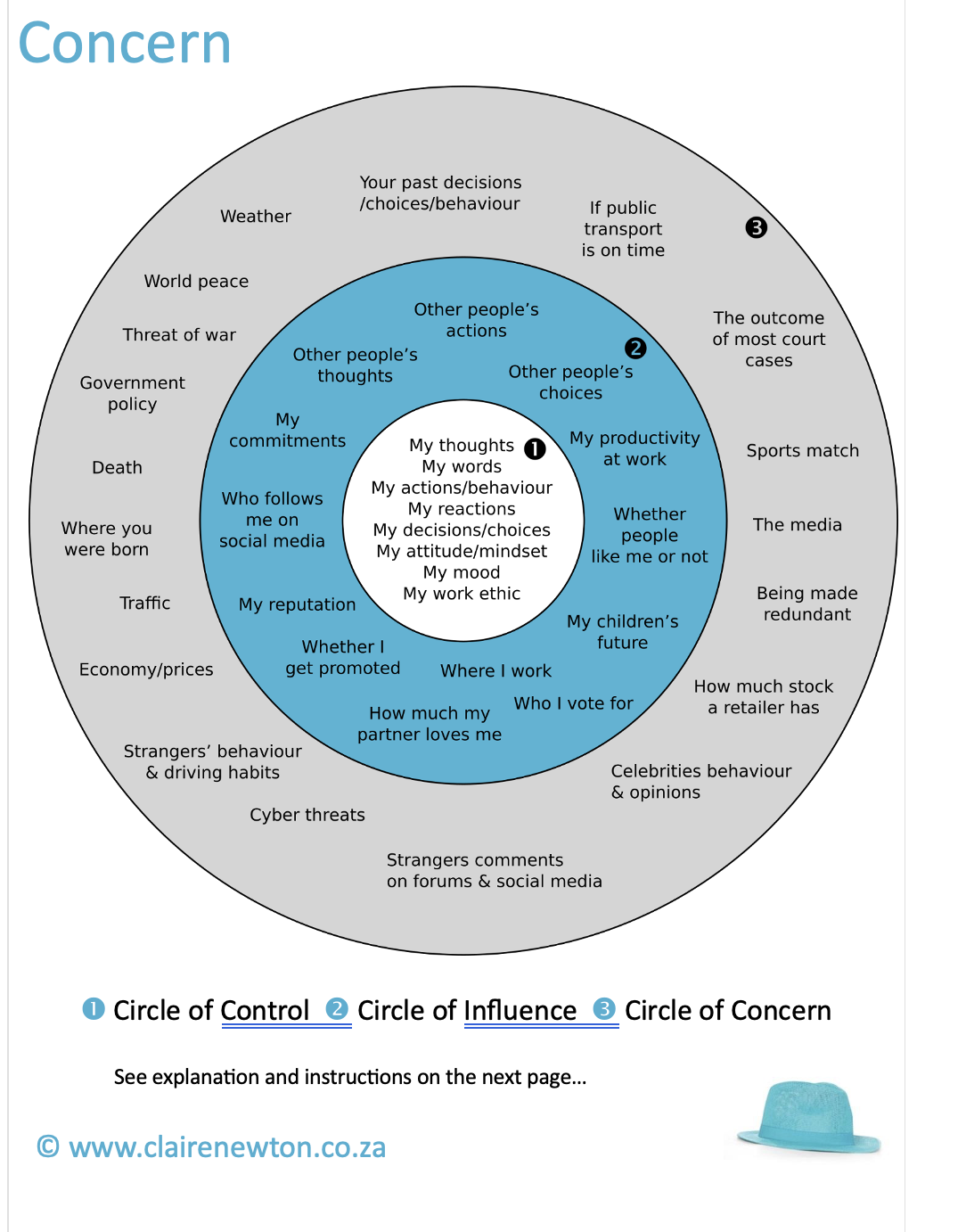
Diagram of Circles of Concern, Influence and Control from www.clairenewton.co.za
The Circle of Concern
The Circle of Concern includes everything you worry about or care about, regardless of whether you can influence it.
Examples include:
The global economy
Climate change
Issues at work such as restructuring, changing policies etc
Other people’s opinions or behaviour
Government policies
The past or distant future
These are real issues, and caring about them is natural. But there will be some things here that you will have no control over and others that you can do something about.
The Circle of Influence
Your Circle of Influence is where you have indirect control over the circumstances or challenges that you care about. If you can’t control a concern, can you influence it? For example, how can you influence your relationships with other people or who you spend time with?
The Circle of Control
Inside the Circle of Infuence lies a smaller but more powerful area: the Circle of Control.
This includes things you can directly influence through your actions:
Your attitude and mindset
How you respond to situations
Your habits and routines
Skills you choose to develop
How you communicate
The effort you put into your work
Focusing here gives you will give you a strong sense of control over your circumstances which, in itself, is empowering. Even small actions within this circle compound over time and can eventually expand your influence outward.
Try this for yourself
- Draw three circles as in the diagramme
- List all the things that are worrying you or annoying you or anything else in the circle of concern
- Review them and move them to either your Circle of Influence (What can I do about this that could influence the outcome?) and Circle of Control (What action can I take about this?)
- All those items that remain in your Circle of Concern then I'm afraid those are best accepted as things beyond your control. Time to let them go.
- Those smaller items in your Circles of Influence and Control are your opportunities for real change - small actions that can shift your experience significantly
Gaining some clarity on what you can, and can’t, change puts you in charge and this is such a powerful mechanism for flourishing at work. You are in the driving seat, as much as is possible, rather than your circumstances. So it’s time to own your own life.
With the warmest of wishes,
Christina
Professor Christina Hughes is Founder and CEO of Women-Space Leadership.
[1] Covey, S (1989) 7 Habits of Highly Successful People, Free Press
[2] Thanks to Claire Newton for such an ace diagramme, https://www.clairenewton.co.za/my-articles/circles-of-control.html